Buying land here is easy.
Making it produce is the work.
Strategy, research, and underwriting for owners, funds, and sovereign nations deploying capital along the Eagle Pass–Piedras Negras corridor. We build the thesis, stress the numbers, and phase the plan — before the money moves.
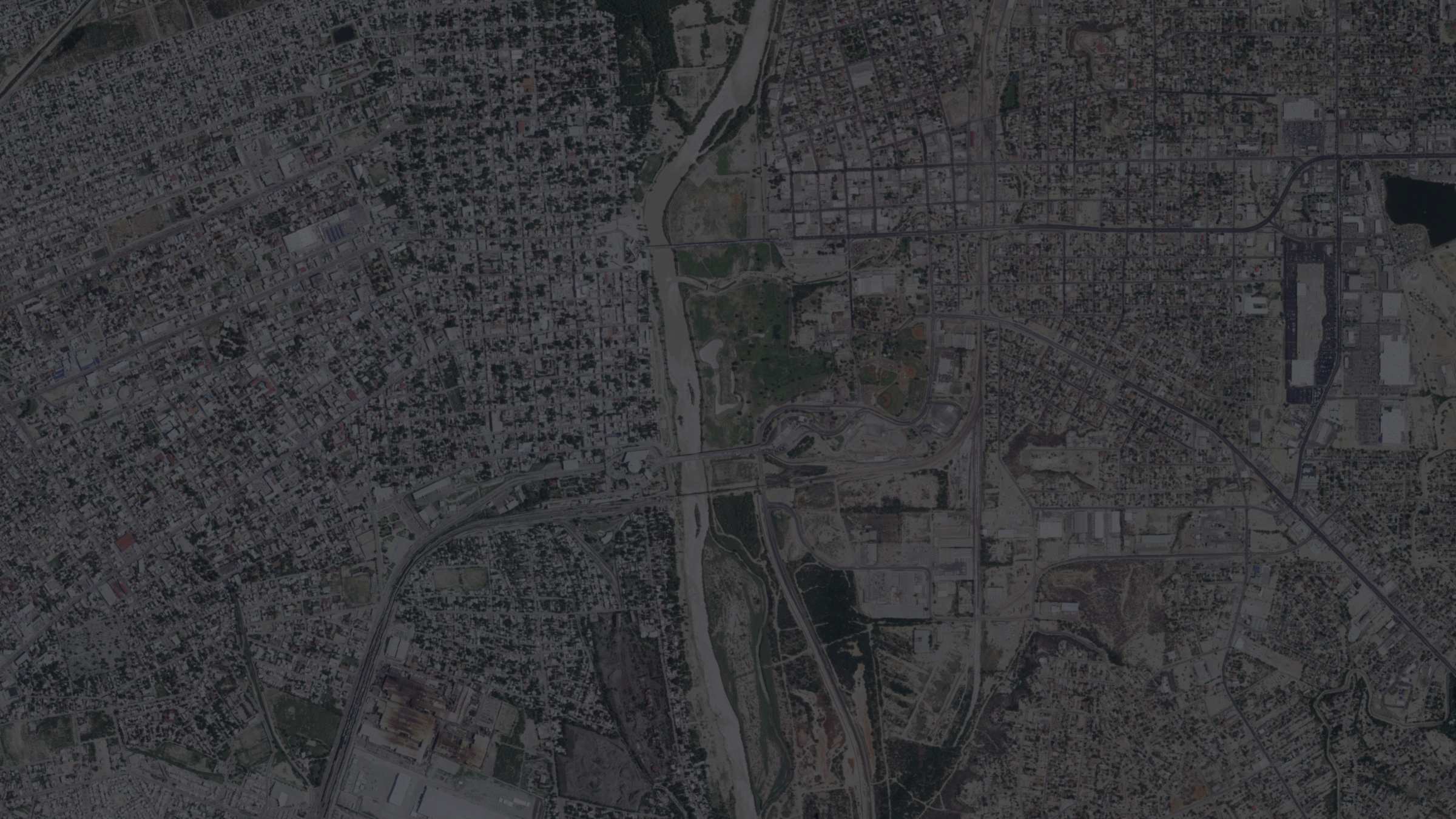
USGS NAIP aerial · public domain
Trade figures: Eagle Pass Business Journal (2025); FreightWaves analysis of U.S. trade data (2024). Project status verified against primary sources as of August 2026 — see the full status board.
A border market is repricing. Most of the capital arriving has no plan.
The port moved $43.57 billion in 2024, up from $7.72 billion in 2005 — but 74.7% of it is rail. The truck figure, which is what fills warehouses, is $11.0 billion. A demand estimate anchored to the headline would be scaled to roughly four times the truck-borne base. We are not aware of a published analysis that makes that error, and we are not accusing anyone of it — we raise it because the headline is the only trade statistic this market publishes about itself.
Two projects are meant to relieve that lane, and they are at completely different stages. They are also substitutes, not additions: the federal environmental statement assumes — on the applicant’s own representation, adopted as the baseline for the whole document — that a built Puerto Verde would take all commercial traffic off Bridge II, in both directions. Summing their capacities double-counts. The same record concedes that the City “would lose revenue associated with tolls and commercial activities,” calls that loss “too speculative” to quantify, and notes the Board lacks jurisdiction to require mitigation for it.
The Camino Real expansion would double the crossing to twelve lanes. Coahuila reported its customs plaza and approach essentially complete during 2025 and moved on to widening the road into Piedras Negras. On the Texas side the design contract was awarded in September 2025 and engineering is still running; as of April 2026 city officials said no execution dates and no total investment had been set. The current target, announced by Coahuila, is an October 2029 opening.
Puerto Verde — a commercial crossing and a rail bridge — is permitted to Maverick County, not to the private developer promoting it. The county's agreement to take a majority stake was agreed in principle in April 2026, was never finalized, and its legality is before a court. The county judge who championed it was suspended from office in May 2026 and then lost his primary. Mexico has named the crossing in a federal investment program; no tender has been issued and no contract awarded.
Land is being assembled anyway — by tribal enterprises, funds, family capital, out-of-market buyers reading the trade numbers. Almost none of them have underwritten the years in between.
The harder problem is that the published record here is thin, dated, or written by someone with a stake in the answer. A permit reads like a bridge. Buying without knowing the difference is how a good corridor becomes a bad basis.
Establish the objective
What is this capital supposed to do? Yield, jobs, sovereignty, generational hold — every recommendation downstream changes with the answer.
Read the market from the ground
Including what never reaches a data provider: who controls what, which parcels move, what the municipality will support.
Build and stress the case
Every scenario carries its own capital stack, timeline, and risk register. We argue against our own recommendation first.
Phase it
Year one, what it costs, and what it has to prove before year two gets funded.
Six ways we are put to work.
Investment Thesis & Market Entry
Where the capital should go, and what has to be true for it to work.
Land Strategy & Highest-and-Best-Use
What the ground supports, phased and costed. Acreage into a program.
Acquisition Underwriting & Diligence Oversight
Independent analysis of a deal before it is committed.
Portfolio & Asset Strategy
Hold, reposition, or exit — asset by asset.
Development & Capital Partner Sourcing
Finding, vetting, and structuring the partners a project needs.
Corridor Research & Market Intelligence
Standing quarterly coverage of the Eagle Pass–Maverick County market.
Different mandates. The same unanswered question.
Sovereign Nations & Tribal Enterprises
Master planning, acquisition screening, and partner sourcing for councils and development corporations.
Landowners & Family Capital
You bought well. What now? A ranked set of uses and a phased plan with the numbers attached.
Funds, REITs & Family Offices
Independent underwriting and parcel-level ground truth, from inside the market.
Corporate Occupiers & Developers
What is available, what the municipality will support, and where the infrastructure is going.
Three ways to engage. Pick the one that fits the decision.
A two-to-three-week Diagnostic Sprint when you are still framing the question. A Strategic Retainer when the decisions keep coming. A Project Mandate for one defined outcome on one asset. Scope, deliverable, and fee agreed in writing before any work starts.